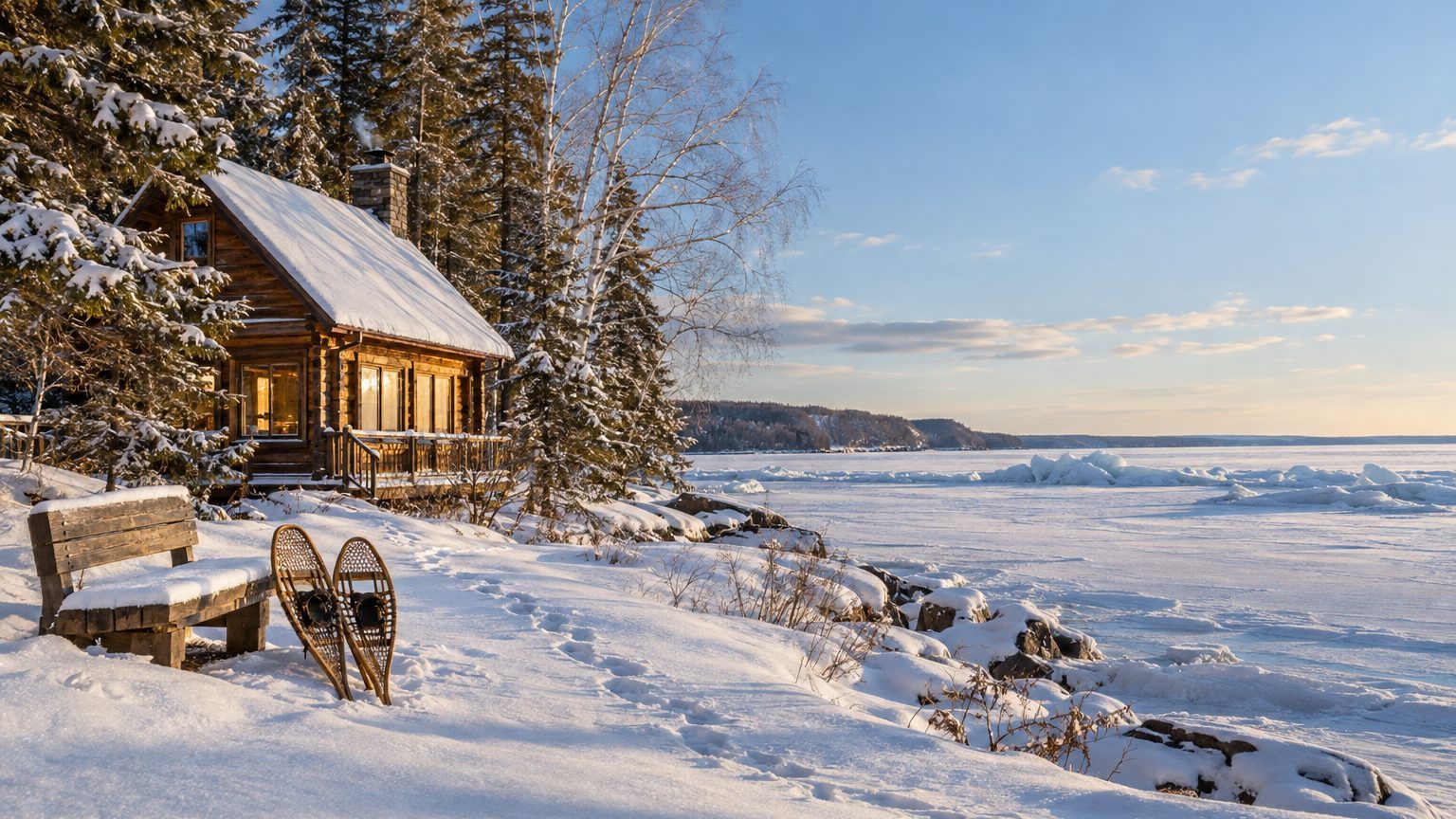
For a Wisconsin winter weekend, pick by style. Door County (Fish Creek, Ephraim, Sister Bay) suits quiet inn stays and snowshoeing. Bayfield on Lake Superior is the pick for ice scenery. The Northwoods (Eagle River, Minocqua, Hayward) is best for cabins, snowmobiling and dependable snow. Lake Geneva and Wisconsin Dells are the easy resort options, and Cable is the cross-country skiing base. Southern counties average near 30 inches of snow a year, while totals above 150 inches are common in the counties just south of Lake Superior. Late January through February is the most reliable window. Book cabins early and check the heat source, road access and cancellation terms before you pay.
Which Wisconsin towns are best for a winter weekend?
Door County: Fish Creek, Ephraim and Sister Bay for quiet, cozy inns
Door County is worth visiting in winter if you want quiet more than a full itinerary. Some restaurants, shops and lodging properties close for the season or run reduced hours, and snow and ice conditions can change quickly. Sturgeon Bay, the county’s largest city, has more year-round restaurants and attractions than the northern villages, so it is a practical home base. The payoff is empty trails. Peninsula State Park has 16 miles of groomed, mostly double-tracked ski trails. Cave Point County Park (cold years bring ice to the sea caves) is the scenic stop when the weather cooperates.
Bayfield and the Apostle Islands: lake-ice scenery and small-town lodging
Bayfield sits in the Lake Superior snowbelt, so the town itself is reliably wintry. The ice caves are another matter. From 2000 to 2023 the mainland ice caves were open for only 2 percent of all days. The last openings were a nine-day stretch in 2015 and one day in 2026, which ended when the ice shelf broke up in less than 16 hours during a storm. Book a lake-view inn for the small-town atmosphere and the frozen shoreline, and treat the caves as a bonus rather than the plan.
Northwoods towns: Eagle River, Minocqua and Hayward for snowmobiling and cabins
This is cabin country. The Eagle River “500” is nearly 600 miles of interconnected trails, and the local chamber calls the town the Snowmobile Capital of the World. The World Championship Snowmobile Derby takes place there every January. Minocqua adds the Bearskin State Trail, an 18-mile former rail corridor through Oneida County forest that connects to the Hiawatha Trail. Hayward anchors the western Northwoods and sits a short drive from Cable. Even in this snowy region, lake ice is not a groomed, marked trail and conditions change, so ask locally before riding on ice.
Lake Geneva and Wisconsin Dells: easy trips with resort or indoor options
These two towns trade snow reliability for convenience. Lake Geneva has downhill skiing at Grand Geneva and Alpine Valley, plus Winterfest, which runs February 3 to 7, 2027. The snow sculpting competition is still part of it, now billed as America’s Snow Sculpting Invitational. One honest detail: Grand Geneva’s Mountain Top relies on snowmaking to supplement natural snowfall. The Dells is a rain-or-shine trip. Wilderness Resort keeps four indoor waterparks open year-round, and Kalahari’s indoor waterpark is open year-round, though it lists short maintenance closures in mid-December.
Cable and Telemark: cross-country skiing weekends
Cable is the base for Nordic skiing. The 2027 U.S. Cross-Country National Championships run January 2 to 7 in Cable, and the American Birkebeiner follows in February. If you ski at a state park instead, remember that Wisconsin treats ski trail passes and park stickers separately (details below).
| Region | Weekend style | Best winter activities | Typical lodging | Best months | Main risk | Drive time |
|---|---|---|---|---|---|---|
| Door County | Quiet inn escape | Snowshoeing, ski trails, fish boils | Inns and B&Bs | Late January to February | Reduced seasonal hours | About 3 to 3.5 hours from Milwaukee |
| Bayfield / Apostle Islands | Ice scenery | Lakeshore walks, snowshoeing, ice caves only when open | Lake-view inns | February | Thin or unsafe ice; caves rarely open | About 4 hours from the Twin Cities |
| Eagle River | Snow-sports cabin | Snowmobiling, derby events | Cabins and resorts | January to February | Thin lake trails early and late | About 4 to 4.5 hours from Milwaukee |
| Minocqua | Lake-town cabin | Snowmobiling, state trail riding | Cabins and lodges | January to February | Limited dining on slow weeknights | About 4 to 4.5 hours from Milwaukee |
| Hayward / Cable | Nordic skiing | Cross-country skiing, Birkie Week | Cabins and lodges | Late January to February | Event weekends sell out | About 2.5 to 3 hours from the Twin Cities |
| Lake Geneva | Easy resort weekend | Downhill skiing, Winterfest | Resorts and lake inns | Early February | Limited natural snow in the far south | About 1 hour from Milwaukee |
| Wisconsin Dells | Family indoor resort | Indoor water parks, snow tubing | Water park resorts | January or any weather | Little snow; outdoor parks closed | About 2 hours from Milwaukee |
What is there to do in Wisconsin in winter besides skiing?
Snowshoeing and cross-country trails in state parks and forests
Wisconsin’s state parks are an inexpensive winter option, with one catch. A vehicle admission sticker is required for entry to most state park properties. State trail passes are not required for hiking or snowshoeing but are needed for skiing on the trails that require them. That rule varies by park: Blue Mound requires a trail pass for skiers 16 and over, while Yellowstone Lake does not. Also, hiking and snowshoeing are not permitted on designated ski trails. Kettle Moraine in the south is the easiest option for a day outing.
Snowmobiling and the trail pass rules
Yes, you need a trail pass to snowmobile in Wisconsin. A pass is required to operate a snowmobile on a trail or corridor, and trail passes are separate from registration. Nonresidents need the DNR’s nonresident pass plus current registration from their home state. Passes are sold on the DNR’s GoWild site or at DNR sales agents, and a temporary receipt covers you while the decal is mailed. Riders born on or after January 1, 1985 who are at least 12 need a safety certification course.
Ice fishing, winter festivals and cozy indoor stops (supper clubs, breweries, cheese shops)
Ice fishing runs on a local calendar. In the Lake Geneva area it is a January to February activity, ice permitting, and guides are the safer way to start. Festivals fill the rest: Winterfest in Lake Geneva, the snowmobile derby in Eagle River and Birkie Week in Hayward. For the evenings, Wisconsin’s supper clubs, breweries and cheese shops are the built-in backup plan. In Door County, only some restaurants run winter fish boils, on select days, and Door County Brewing Co. in Baileys Harbor stays open year-round. Call ahead, because winter hours shift.
When is the best time to visit Wisconsin in winter?
Late December to early January: holiday lights, with the highest prices and crowds
This is one of the prettiest and priciest stretches. Ski areas are opening, with Granite Peak projected to open November 21 and Wilmot December 4, and the Christmas-to-New-Year week is when indoor resorts fill and prices rise. Snow is the gamble. Early-season cover in the south and along Lake Michigan is thin in many years, so lean on the Northwoods or a resort with snowmaking.

Late January to February: the most reliable snow and ice, plus major events
This is the window to book. It carries the derby in Eagle River, Winterfest from February 3 to 7, and Birkie Week from February 24 to 28, 2027. The race itself is Saturday, February 27, a 50K skate or 53K classic ending in downtown Hayward. Roughly 40,000 spectators and skiers gather in the Cable and Hayward area, so lodging goes early. Lake Superior ice is also most likely to form in February, though the ice caves still depend on a rare mix of conditions.
March: sugar-bush season, thinning ice and fewer crowds
March is for maple sugaring, quieter towns and spring-skiing laps. The regional ski season typically runs from late November through March. The tradeoffs are soft snow and thinning ice. Snowmobile trail systems can close before the end of March, and lake trails go first.
Before you drive, check four things:
- The National Park Service ice cave status page and its ice caves information line.
- Trail grooming reports from the state park or ski club you plan to use.
- Snowmobile trail conditions from the local chamber (Eagle River, Minocqua or Hayward).
- Road conditions on 511 Wisconsin, especially in the north.
How do you book a winter cabin in Wisconsin, and what should you check first?
Cabin types: private rentals, resort cabins and state park cabins
Private rentals vary the most, from heated lodges with hot tubs to rustic camps. Resort cabins usually mean staffed check-in, plowed lots and trail access. State park cabins are a narrow option. The DNR’s cabins are mostly accessible cabins for people with disabilities, and many are seasonal, so check the DNR reservation site for winter dates. Winter state park stays are mostly campsites: year-round reservations are offered at more than 20 parks and forests, but not all campsites or campground roads are plowed. Copper Falls, for example, keeps six plowed campsites for winter by reservation only.
Pre-booking checklist: heat source, road access, minimum stays, cancellation terms
Photos sell cabins. These five questions decide whether the weekend works:
- Heat source: furnace, wood stove or electric baseboard, and whether there is a backup if the power goes out.
- Plowed access: who plows the driveway, how long and steep it is, and whether a two-wheel-drive car is fine.
- Firewood: whether it is included, how much and where it is stored.
- Minimum stays: holidays and Birkie weekends often require multiple nights.
- Cancellation terms: what happens if a storm closes the roads or the snow does not come, and whether you get a refund or a credit.
Frequently Asked Questions
Does Wisconsin have good skiing?
It has good small-scale skiing and excellent Nordic skiing. Granite Peak’s 700-foot vertical drop and 400 acres make it the state’s biggest and tallest resort. Cascade Mountain, Devil’s Head and Wilmot are smaller but convenient for southern visitors. Cross-country skiing around Cable and Hayward is where Wisconsin competes with anyone in the Midwest.
Are the Apostle Islands ice caves open every winter?
No. They were accessible on only about 2% of days from 2000 to 2023 and opened for a single day in February 2026, after not opening since 2015.
Do you need a trail pass to snowmobile in Wisconsin?
Yes, for trails and corridors. Antique-registered snowmobiles are exempt. Buy through the DNR’s GoWild system or a DNR sales agent before you go.
Is Wisconsin Dells open in winter?
Yes, mainly indoors. The big resorts keep their indoor water parks running all year, while outdoor parks close for the season. Check each resort’s calendar for short maintenance closures and for seasonal extras such as tubing or skiing, which usually start in late December.
How cold does Wisconsin get in winter?
Cold enough to plan for it. Northern Wisconsin regularly sees subzero nights in January and February, and the Lake Superior ice caves require subzero temperatures plus low winds. The south is milder but still brings wind chill, so pack layers whichever region you choose.
For wider options beyond the state line, see these winter weekend getaways, or if you are leaving from Illinois, Winter Weekend Getaways From Chicago.
Sources: apps.dnr.wi.gov | climatology.nelson.wisc.edu | dnr.wisconsin.gov