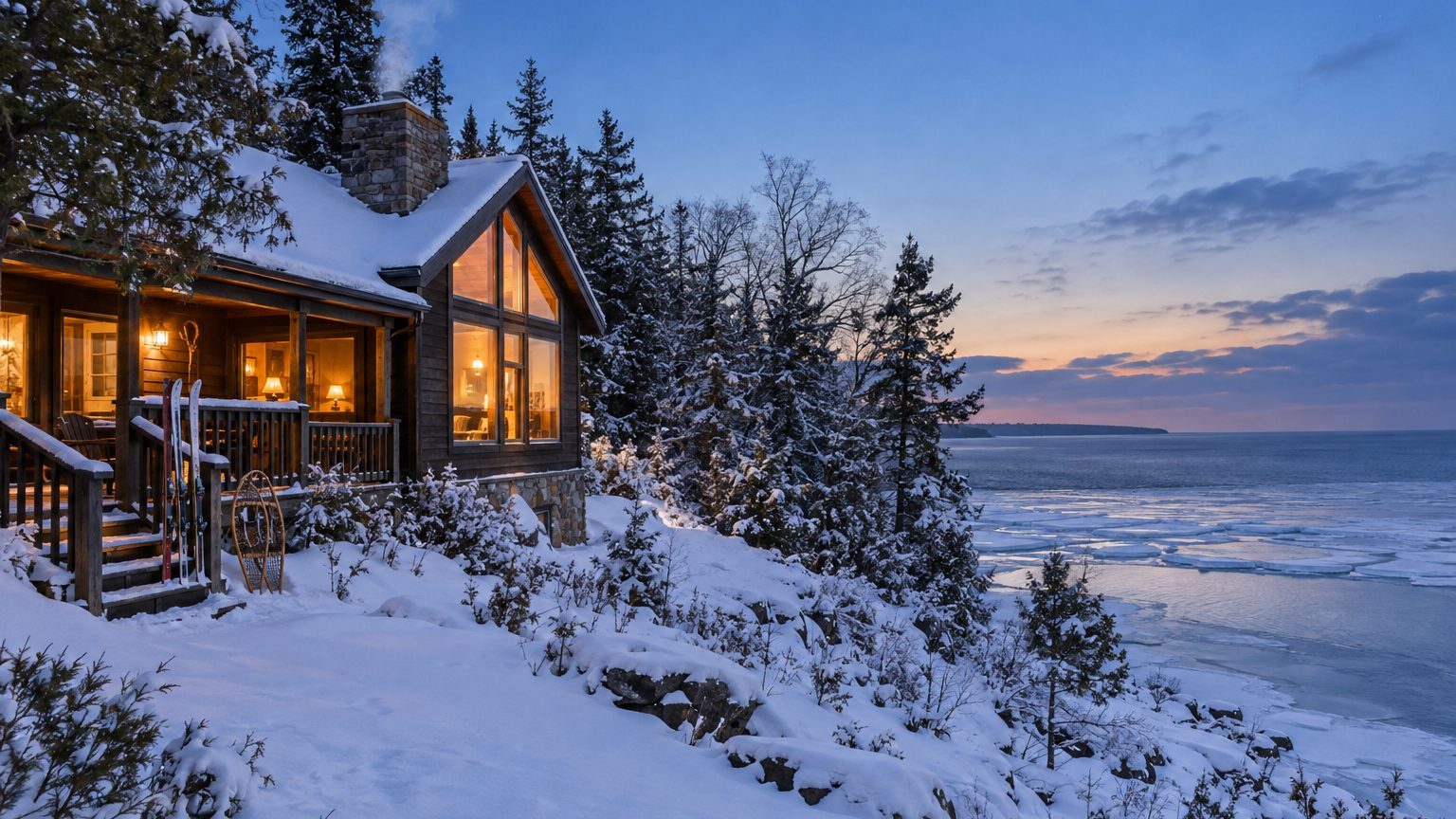
Choose Minnesota’s North Shore (Duluth to Grand Marais) or Ely if you want dependable snow, skiing, snowshoeing and dog sledding. Choose Wisconsin (Door County, Bayfield, the Dells) for snowy lake scenery, cozy inns and a drive that works from Chicago or Milwaukee. Choose Ohio (Hocking Hills, Cuyahoga Valley, the Lake Erie shore) for a short, low-key cabin weekend, knowing that snow is far less certain. Whichever you pick, aim for mid-January through February and book lodging with flexible cancellation.
Which Midwest state is best for a winter weekend: Wisconsin, Minnesota or Ohio?
Minnesota is the snow-and-cold pick.
Duluth averages about 90 inches of snow a year
, and
its 1991–2020 January normals show an average high near 19°F and a low near 2.5°F
. Ely sits inland and runs colder still, with
a January average high of 14.2°F and a low of -0.8°F
. Dog sledding trips there generally
run from December through March
, though March depends on how much snow is left. Skip it if you dislike extreme cold. The far North Shore and Ely are not the places to learn that lesson.
Wisconsin offers the best balance of scenery and comfort, and our guide to Wisconsin Winter Getaways covers the best towns and cabins in more detail. Door County gives you Lake Michigan shoreline, state park ski and snowshoe trails and inns with fireplaces. Bayfield puts you at the edge of Lake Superior and the Apostle Islands. The Dells trades solitude for indoor water parks, which is the right call with kids who will not tolerate a two-mile snowshoe. Snow here is real but uneven from year to year. Skip it if guaranteed deep snow is the priority, and expect some Door County shops and restaurants to cut winter hours.
Ohio is the easy one. Hocking Hills trails
are open year-round, from a half hour before sunrise to a half hour after sunset
, and
the gorge at Old Man’s Cave and the amphitheater at Ash Cave collect impressive ice after a few days of below-freezing temperatures
. Columbus
averages a 37°F high, a 22°F low and 9.5 inches of snow in January
. Snow can swing wildly:
after four straight below-normal seasons, Columbus had 27.1 inches by the end of January 2026
. Skip it if you need a snow globe rather than a frozen waterfall.
| Base | Best for | Snow reliability | Typical January range (approx.) | Drive from nearest hub | Trip length |
|---|---|---|---|---|---|
| Door County and Bayfield (WI) | Scenery, inns | Medium | About 8–25°F | Door County 4–4.5 hrs from Chicago; Bayfield about 4 hrs from the Twin Cities | 3 nights |
| Wisconsin Dells (WI) | Family resorts | Variable | About 10–27°F | About 3 hrs from Chicago | 2 nights |
| Duluth and the North Shore (MN) | Activities, scenery | High | About 3–19°F | About 2.5 hrs from the Twin Cities; Grand Marais about 2 hrs farther | 2 nights (Duluth), 3 (Grand Marais) |
| Ely (MN) | Dog sledding, snowshoeing | High | About -1 to 14°F | 4–4.5 hrs from the Twin Cities | 3 nights |
| Hocking Hills (OH) | Cabins, frozen waterfalls | Variable | About 22–37°F | About 1 hr from Columbus | 2 nights |
| Lake Erie shore / Cuyahoga Valley (OH) | Easy hikes, lake views | Medium | About 21–34°F | Under 1 hr from Cleveland | 2 nights |
Before booking any of these, confirm the heating setup, winter road access, seasonal closures and cancellation terms. The checklist at the end of this guide covers each one.
When is the best time to visit the Midwest for snow?
Mid-January through February is the safest window, and it is also the coldest. Duluth’s January snowfall averages about 17 inches, and Ely’s overnight lows regularly dip below zero. Wind chill, not the thermometer reading, sets your real limit on a snowshoe day. Pack for the gust, not the average.
Early December is cheaper and quieter, but the lakes are still making ice and the snow cover is thin or patchy. The Minnesota DNR says
four inches of new clear ice is the minimum thickness for travel on foot
, so lake walks and ice fishing often have to wait. In the first weeks of winter you are mostly buying atmosphere, not snow. Deep winter brings crowds, though. The
Saint Paul Winter Carnival draws over 100,000 visitors and runs January 28 to February 7, 2027
. Hocking Hills has its own crowd magnet, a free winter hike of about six miles,
scheduled for Saturday, January 16, 2027
.
Location beats the calendar, and you can rank any destination with three questions. How far north is it? Cold keeps snow on the ground, which is why Ely and the North Shore stay white long after Columbus has melted. Does a lake feed it? Lake-effect snow is a bonus, but it depends on wind direction and open water, so it shifts from year to year. Is the snow inland or lakeshore? Inland snowpack is steadier. Lakeshore snow arrives in bursts and sometimes turns to rain. Apply that to the map. Duluth gets both latitude and Lake Superior. Ely gets latitude alone, with about
71 inches over a typical winter
. Door County gets Lake Michigan moisture without the deep cold. The Lake Erie snowbelt east of Cleveland can bury towns while Columbus sees a dusting. Check current conditions in the week before you go, whatever the averages say.
How far should you drive for a Midwest winter weekend?
Chicago to Door County is
roughly 250 miles, about 4 to 4.5 hours non-stop
, and
rush hour around Chicago and Milwaukee can add a frustrating amount of time
. The Dells sit about three hours out. From the Twin Cities, Duluth is roughly 2.5 hours.
Duluth to Grand Marais adds about two hours
, and Ely is
245 miles from Minneapolis, about 4 hours 25 minutes in normal traffic
. Ohio is the shortest: about an hour from Columbus to Hocking Hills, and under an hour from Cleveland to Cuyahoga Valley. Winter daylight is short.
In December the sun sets between about 4:15 and 4:45 p.m. in Chicago, the Twin Cities and Duluth
, so a Friday departure for a four-hour drive means arriving in the dark on unfamiliar roads.

The rule of thumb is simple. A one- to three-hour drive suits two nights. Destinations beyond four hours earn a third night, and the extra day should be the best day. Ely justifies three nights because a dog sledding day needs a buffer on each side for weather. Grand Marais,
about 4.5 hours from Minneapolis
, deserves three as well. Door County needs three if you want one full day on skis or snowshoes after the drive. Duluth, the Dells, Hocking Hills and the Cuyahoga Valley all work in two nights. Add a third only when you want a slow day by the fire.
What should you check before booking a lake weekend or cabin in winter?
Winter bookings fail on details that summer guests never think about. Ask these before you pay:
- Heating: wood stove, electric baseboard or furnace, and who stocks the wood or fixes a failure at 9 p.m. on a Saturday.
- Road access: whether the lane is plowed, who plows it, and whether the last stretch is steep or private.
- Seasonal closures: restaurants, visitor centers, ferries, rental shops and trail grooming.
- Cancellation terms: a weather-related refund or credit, plus any weekend minimum stay.
- Ice rules: whether the owner allows ice fishing or snowmobiles on the lake, and what gear is provided.
For roads, use MN 511, 511 Wisconsin and OHGO the morning you leave. You do not need four-wheel drive for main routes, which are plowed, but good tires and slower speeds matter more than the drivetrain.
Ice needs its own caution. The DNR says
it does not measure ice thickness on Minnesota lakes
, so safety is your responsibility. Guidelines call for
5 to 7 inches before a snowmobile or small ATV, and 9 to 10 inches before a small car or SUV
.
Ice can be two feet thick in one place and one inch thick a few yards away
. White, snow-formed ice is
about half as strong as clear ice
. Skip the lake activity if the ice is gray, slushy, near moving water or covered in fresh snow you cannot see through. Hire a local guide for your first outing.
Frozen-lake attractions are the least predictable. The Apostle Islands ice caves
were open for only 2 percent of all days from 2000 to 2023
. Even when open, plan on
a 2 to 6 mile round trip on uneven lake ice with no shelter or water
, and
access can close with little notice
. Treat them as a bonus, never the reason to book.
Frequently Asked Questions
Are the Apostle Islands ice caves open every winter?
No.
Stable lake ice allowed access for one day in 2026 and a brief nine-day period in 2015
. Wind and waves can break up thick ice within hours. Check the National Park Service ice caves page or
call the ice line at (715) 779-3398 x3
before you drive.
Is Hocking Hills worth visiting in winter?
Yes, if you want frozen waterfalls, bare-tree views and thinner crowds. Trails stay open year-round, though
closures can happen during severe winter weather
. Bring ice cleats, because
stone steps can turn slick fast
, and expect little snow some weeks.
How cold does it get in Minnesota in January?
Duluth averages a high near 19°F and a low near 2.5°F. Ely’s average low is just below zero. Cold snaps go well beyond that:
the temperature drops below -13°F in Duluth in most winters
. Wind chill can make it feel colder still, so dress in layers and cover exposed skin.
Do you need a 4WD or AWD vehicle for a Midwest winter road trip?
Usually not. Interstates and state highways are plowed quickly, and winter tires or good all-season tires with a full tank and slower speeds do more for safety than a drivetrain. AWD helps if your cabin sits at the end of an unplowed or hilly lane, so ask the host about access. Check MN 511, 511 Wisconsin or OHGO before departure.
Sources: blog-weathertalk.extension.umn.edu | iowadnr.gov | nps.gov