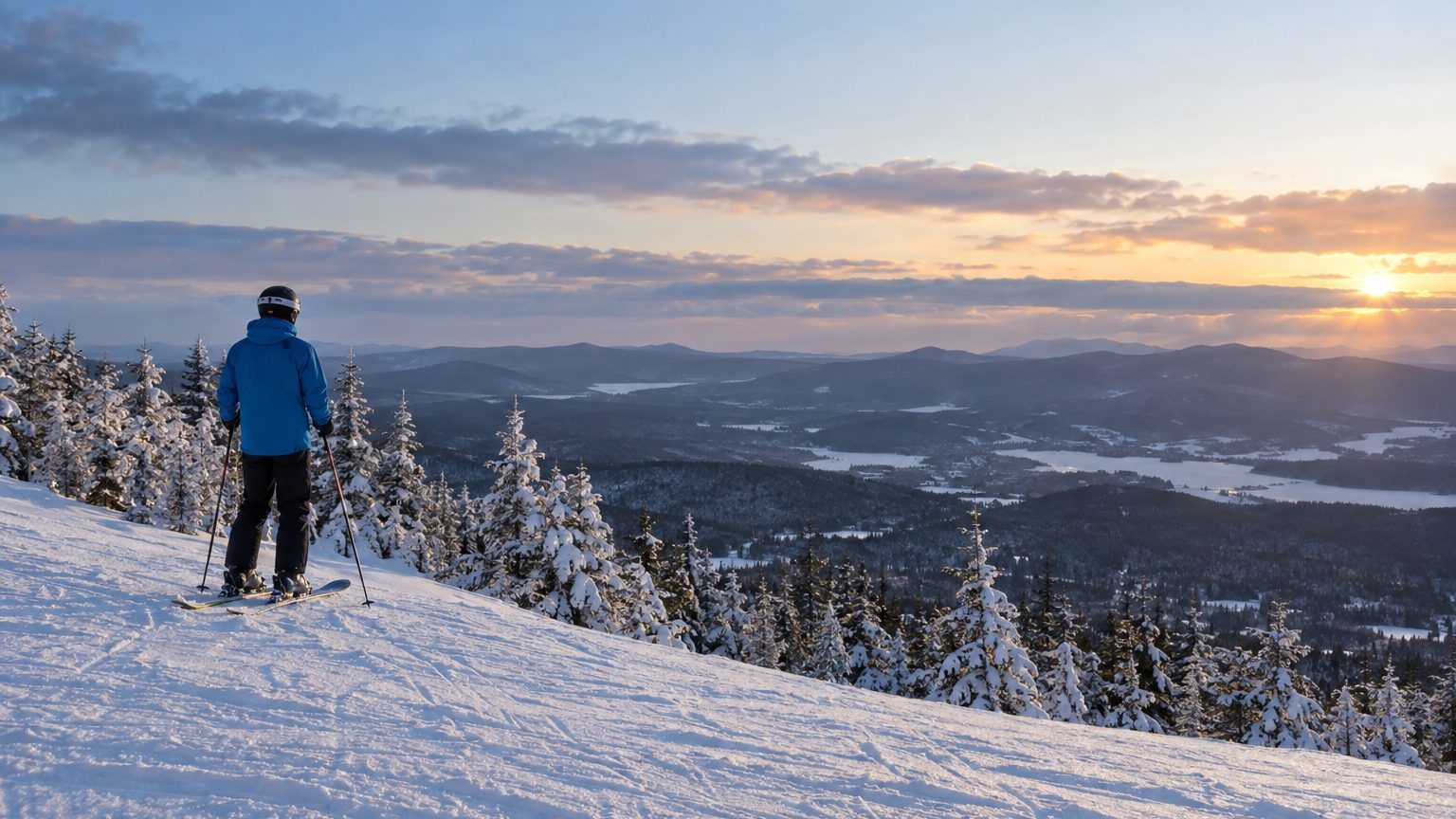
New England in winter comes down to one decision: mountains or coastline. The region has about 87 public ski areas, and New Hampshire has the most with 26. Rhode Island has one. Where you aim your car matters more than almost any other planning choice.
Six states. Wildly different winters.
The big mountains: Vermont, Maine and the White Mountains
Vermont is the default answer for skiers, and the numbers back it up. It has more than 16 ski areas spread from Bromley and Stratton in the south to Jay Peak and Smugglers’ Notch near the Canadian border. Stowe, on the state’s highest peak, is the postcard version, with a village that works even if you never clip into a binding. Killington has long been known for one of the longest seasons in the East, and its projected opening this year is November 11, the earliest on the regional list.
Jay Peak has a reputation for deep snowfall and tree skiing that confident skiers chase. Mad River Glen, in central Vermont, is a skiers-only mountain, so snowboarders need to look elsewhere. Okemo is marketed on its snowmaking and grooming, which counts for a lot in a region where natural snow can’t be taken for granted. Families tend to like it for that predictability.
Maine rewards the longer drive.
Sugarloaf, Sunday River and Saddleback pull skiers from hundreds of miles away to high summits with dry snow, and the lift lines are often shorter than in Vermont. Sunday River is projected to open around November 15. The nearby town of Bethel works as a base because it offers snowshoeing, cross-country skiing and other options on days when your legs have quit. Pack a layer more than you think you need, because inland Maine in January is a different climate from Boston.
New Hampshire sits in the middle, both geographically and in character. Bretton Woods, Cannon, Loon and Attitash sit in or near the White Mountains, and Cannon and Bretton Woods are both projected to open in mid to late November. Mount Sunapee, about an hour and a half north of Boston, suits a weekend where you want more skiing than driving. For a splurge, the Omni Mount Washington Resort is the grand old hotel of the region.
Winter towns for people who’d rather not ski
Not everyone in the group wants to be on a mountain at 8 a.m. Plenty of New England’s best winter weekends are built around a town, a fireplace and a short walk to dinner.
Woodstock, Vermont, is often named among the state’s prettiest towns, and winter suits it. You can snowshoe or cross-country ski, or ski downhill at the small Saskadena Six area nearby. Manchester, in the south, adds shopping and historic sites to its skiing and hiking. Stowe has an après-ski scene strong enough to justify a trip without any skiing at all, plus the Austrian-style Trapp Family Lodge.
Coastal Maine is the quieter bet. Portland has a serious food scene, and Portland Head Light looks better against a gray winter sea than it does in the July crowds. Camden is home to the Camden Snow Bowl, where an old wooden toboggan chute lets you ride down with zero technique and a good deal of screaming. Kennebunkport and Freeport round out a coastal loop that rarely requires a chain-equipped vehicle.
Southern New England covers the easy, low-commitment option. Newport’s mansions are open to visitors in the off-season, western Massachusetts has beginner-friendly hills like Jiminy Peak (which now runs entirely on renewable electricity), and Connecticut has small ski areas that can be done as a day trip. A weekend there costs less and demands far less driving.
Then there is the strange stuff. Ice climbing draws people to the White Mountains and Smugglers’ Notch, snowmobile trail networks cover much of northern New England, and Great Brook Ski Touring Center in Carlisle, near Boston, sets up a one-mile lantern loop for cross-country skiers on select winter nights.
Timing a trip for winter 2026-27
Forecasts for this season disagree, and that is the honest summary. NOAA’s outlook favors a warm northern tier across December through February, with New England leaning slightly wet, and it adds that snow generally can’t be predicted more than a week out. A strong El Niño is in the mix, which in past winters has tilted the Northeast toward warmer temperatures and below-average snowfall.
Other seasonal outlooks go the opposite way. Some call for colder-than-usual weather and heavier snow from central New England southward through the Appalachians, with the biggest storms landing in January and February. One analysis of early-season snowpack found the Green and White Mountains running a few inches below normal. Last winter, for what it’s worth, was a good one for the East.
The practical takeaway is to hedge your bets.
Mid-winter is the safest window. Historical patterns for El Niño years point to January as the strongest month, with November and March weaker, so a late-January trip carries the best odds. Elevation also matters more than usual in a warm year, so favor higher, snowmaking-heavy mountains such as Killington, Sunday River or Stowe over small low-lying hills. Book lodging with flexible cancellation if you can, and watch the forecast the week before you leave, since that is the only stretch when snow forecasts are actually reliable.
Driving deserves its own plan. Northern roads can ice up quickly, and a nor’easter can turn a two-hour drive into six. Check the state transportation department’s road conditions before leaving, keep the tank above half, and carry a blanket, a shovel and a phone charger. Weekends around Martin Luther King Jr. Day and February school vacation week fill up first and cost the most, so midweek stays are the cheaper play.
If you’re torn, pick by the group rather than the postcard. A mixed group of skiers and non-skiers does best in Stowe or Woodstock, where the village carries half the trip. A couple chasing quiet should look at Maine’s coast or Bethel, while a group of friends who just want runs should go straight to Killington or the White Mountains. And with a slow snow year possible, a town with a spa, a restaurant and a decent bookstore is a fine backup plan.
One last detail: ski areas’ opening dates are projections, not promises, and the first lifts of the season often serve only a few trails.
Sources : severe-weather.eu | snowbrains.com