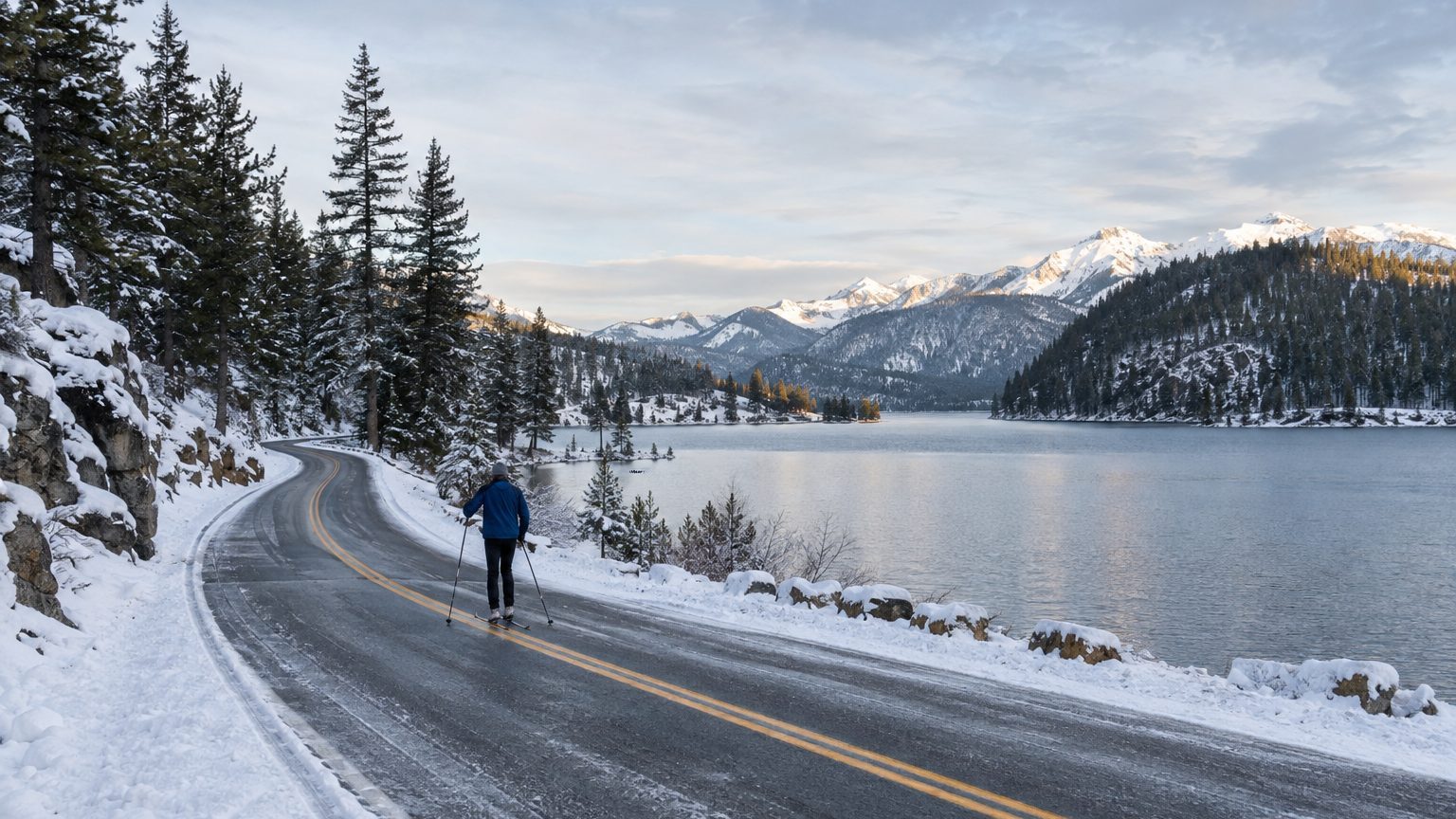
Every winter, Going-to-the-Sun Road shuts down between Lake McDonald Lodge on the west side and Jackson Glacier Overlook on the east. The lower west end stays open, running from the West Entrance through Apgar Village to the gate just past Lake McDonald Lodge, roughly 10 to 11 miles of plowed pavement. The park announced this year’s closure on October 19, the third Monday of October, which is the date the alpine section is set to close each year. Storms can force it earlier, and one did on October 9, 2026, before the road reopened and then closed for the season.
The reason is snow load. The high segments get more snow than plows can handle, and the National Park Service says avalanche danger across the road continues into late spring. The park also says the lower-elevation sections of the road stay open all year. That makes a Lake McDonald weekend possible in January, even though a drive over Logan Pass is not.
The plowed road ends just past Lake McDonald Lodge, and the east side offers about a mile and a half
Coming in through West Glacier, you pass Apgar at the foot of Lake McDonald, then follow the lake’s eastern shore. The gate sits just past the lodge, which is closed for the season, but its parking lot stays open for winter recreation, according to the National Park Service. That lot is the practical trailhead for everything beyond the gate. Heavy storms can still close the plowed stretch temporarily, so check conditions the morning you drive. Text GNPROADS to 333111 for road alerts.
The east side is a different story. The Glacier National Park Conservancy says the stretch from the West Entrance through Apgar Village to Lake McDonald Lodge and about a mile and a half on the east side are the only roads maintained in winter. That means no through-driving between the two entrances. Anyone heading from West Glacier to St. Mary has to take U.S. Highway 2 along the park’s southern edge, which stays open year-round. Montana’s seasonal closures list covers the state routes outside the park, and those close on their own schedule.
Inside the park, services thin out quickly. Visitor center hours in winter are limited, with Apgar typically open on weekends when staffing allows. Most park lodging is closed. Visitors generally stay in West Glacier, Columbia Falls, Whitefish or Kalispell. Whitefish has the widest choice of hotels and restaurants, plus Whitefish Mountain Resort for downhill skiing, which Glacier itself does not offer.
Logan Pass has fully opened between June 13 and July 13 since 2010
There is no set reopening date. The park says there is no set date for the road to open over Logan Pass and that it has typically been fully open by early July. The date depends on plowing. Crews start in early April and work across roughly 40 avalanche paths. Storms and slides often continue through May, and some sections have to be plowed twice.
The recent record shows the spread. Since 2010 the full opening has landed between June 13 (2023) and July 13 (2011, 2020 and 2022). It opened June 16 in 2025 and June 22 in 2026. Across the nine decades of records, the median opening is around June 12 or 13. The earliest was May 16, 1987. That earlier pattern has shifted, and openings since 2010 have mostly fallen in the second half of June. For anyone who needs the whole road, a trip booked after about June 25 has good odds, while July 4 weekend is safer still.
Before the full opening, access improves in steps. The lower sections stay open all year, and the closure point on the west side moves up the valley as plows advance. The road typically opens to hikers and bikers beyond the vehicle closures from early May until cars are allowed. Road-crew closures apply Monday through Thursday while plowing is under way. Avalanche-hazard closures apply at all times, and violating a closure can bring a fine of up to $5,000 and up to six months in jail, according to the park.
Skiing the closed road to McDonald Falls is the signature winter outing
Once the gate closes, the unplowed road becomes a trail for skiers and snowshoers. It is not groomed, so expect to break trail unless someone has gone before you. The park’s winter route notes give distances from the lodge lot. Skiing up the road 1.8 miles and turning left leads to the bridge over McDonald Creek and a view of McDonald Falls. The Sacred Dancing Cascade loop is 5.3 miles round trip. The Avalanche Picnic Area is about 5.8 miles one way, or 11.6 miles round trip. The same park page adds that Avalanche Lake has steep, narrow sections that are hard to ski when icy, and that the Trail of the Cedars is generally poor skiing.
Near Apgar, the options are shorter. Lower McDonald Creek runs two to three miles through forest and along the creek, and the Apgar Lookout route is a steeper climb of about 7 miles round trip that suits experienced snowshoers. Stay off the frozen lakes. Ice thickness on Lake McDonald and St. Mary Lake is unreliable, and help is far away.
The park’s winter guidance is blunt about avalanche terrain. Beyond the lower road, the route climbs into slide paths, and the Park Service warns that avalanches can cross the road in winter and spring. Higher areas call for avalanche training, equipment and a current forecast. Ranger-led snowshoe walks usually run on weekends from late December to mid-March out of the Apgar Visitor Center. They are free, rentals run about $2, and they are weather-dependent, with cancellations in severe cold.
Camping is limited but possible. Apgar Picnic Area and St. Mary Campground are open for car camping, and Loop B of Apgar Campground is open for primitive camping. From November 1 through April 30, backcountry camping requires a winter wilderness permit obtained online, and travel must be human-powered. Wood fires are prohibited, except for fueling a personal stove. Snowmobiles are not allowed inside the park boundary, but guided tours run in the national forest outside it. Winter sunrise light on the Apgar shoreline makes the lake dock the easiest first stop, and it requires no gear beyond boots and a warm layer.
Reaching the park from Whitefish takes about 40 minutes to West Glacier, a short enough drive for a day trip with a hotel bed back in town. The ranger-led walks, the lodge lot and the road status alerts are the three things worth confirming the day before you leave.
Sources : nps.gov | glacier.org