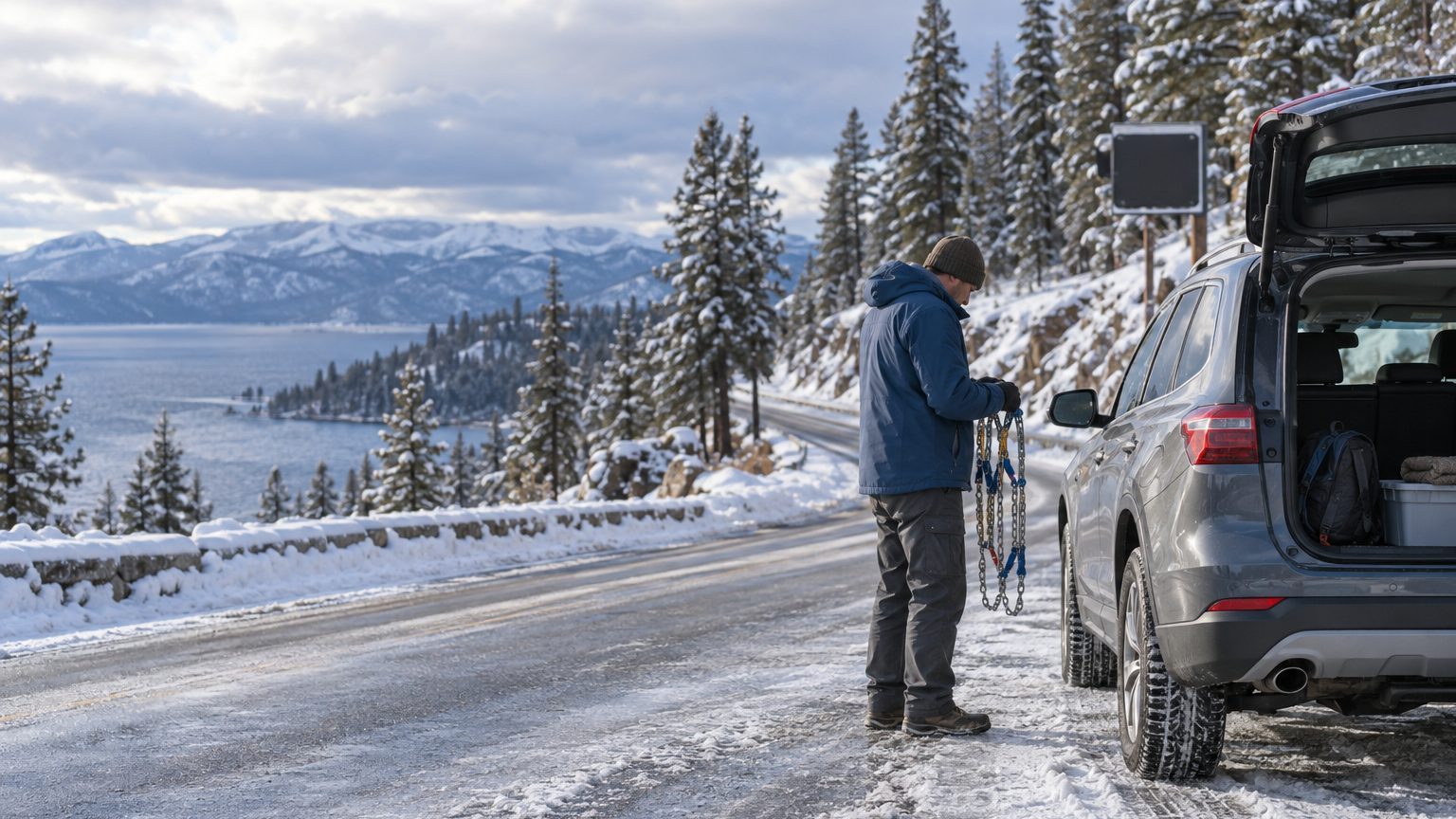
Sometimes, yes. Whether you chain up depends on the storm and on the car you’re driving. In a chain control zone, though, even an all-wheel-drive SUV must carry traction devices, and Caltrans states that outright.
Chain season runs roughly November through April.
Three levels, one rule that never bends
California uses three tiers of chain control, labeled R1, R2 and R3. Under R1, chains are required on all vehicles except passenger cars and light-duty trucks under 6,000 pounds gross weight that have snow tires on at least two drive wheels. Even those exempt vehicles have to carry chains. Anyone towing a trailer must have chains on one drive axle.
R2 is the one most Tahoe-bound drivers meet. Chains or traction devices are required on everything except four-wheel-drive and all-wheel-drive vehicles under 6,500 pounds gross weight that have snow tires on all four wheels. A two-wheel-drive sedan, however good its tires, chains up.
R3 exempts nobody, AWD and snow tires included.
In practice, R3 is rare and short-lived. Conditions bad enough to trigger it usually lead to a road closure soon after. R2 is the everyday storm setting: during one recent winter event, it covered stretches of SR-89 near Tahoe City, SR-267 between Northstar and Kings Beach, and US-50 from Twin Bridges to Meyers, along with I-80 from Cisco to Truckee. Those are the roads that feed the lake, so a single storm can put several approaches under control at once.
Signs reading “Chains Required” typically give you about a mile before the checkpoint to install them. That’s not much room if you’ve never touched a chain.
The AWD exemption has fine print
Here’s the misunderstanding that sends drivers back down the mountain: “I have AWD” is not the same as “I’m exempt.” The R2 exemption requires snow-tread tires on all four wheels. An AWD crossover on worn all-season tires, with no mud-and-snow marking, gets treated like any other car. At the checkpoint, that means chains or a U-turn.
Caltrans also reserves the right to keep any vehicle out of a chain control area if it judges the vehicle will struggle there. Officers at the checkpoint have the final word, even if they contradict a road report you read an hour earlier. The CHP enforces the rules and can cite you.
Your owner’s manual doesn’t help either. A manufacturer’s warning against chains isn’t an exemption, and many such vehicles can take cable chains or other alternative traction devices. Without any device on board, you can’t enter the control area. Caltrans also says there’s no provision for parking at a checkpoint and waiting for conditions to improve.
Chains come in several forms. Traditional link chains are the classic choice. Cable chains, textile snow socks, hub-mounted systems and automatic chains all count as alternative traction devices, and the right one for your car depends on tire clearance.
Rental cars: where the rules collide
This is the trap. Many rental companies don’t let you put chains on their vehicles, and some treat chain use as a breach of the rental agreement that can undermine your damage protection. Check the policy of your specific company before you leave the counter.
The practical consequence is that a rental needs to be exempt from chains in the first place. Standard rental fleets usually run all-season tires, not dedicated snow tires. M+S-marked tires on an AWD SUV can satisfy R1 and R2 in many cases, but “usually” is not a guarantee.
A request for AWD isn’t a promise of snow-rated tires.
Roughly nine rental companies operate at Reno-Tahoe International Airport, with counters in the baggage claim area. A few operators in Reno, mostly off-airport, offer vehicles with true snow tires. You book those separately and they usually cost more, but they take the chain question off the table. Whichever route you choose, reserve early for holiday weekends, since AWD SUVs go first, and read the sidewalls of the tires before you leave the lot. Look for the M+S marking on all four.
If you end up in a car that needs chains and your rental agreement forbids them, you have a decision to make before the mountain makes it for you. Some drivers wait out the storm in Reno or Truckee. Others swap vehicles, or take a shuttle for the final stretch.
Check before you commit to the pass
Chain control status changes by the hour. The Caltrans Highway Information Network, at 800-427-7623, covers California and western Nevada, including the Lake Tahoe and Reno area. Caltrans QuickMap shows live conditions on the same routes. Nevada posts its own road reports at nvroads.com, which matters if you’re approaching from the east.
Buy chains before the trip and test them at home. Fitting them in a dry driveway takes a fraction of the time it takes in a blizzard with the wind at your back. Roadside installers do work at the checkpoints, but they’re independent businesspeople, not Caltrans employees, and you’ll negotiate with them yourself.
When you’re finished, don’t stop on the shoulder in the middle of the control zone. Drive past the “End of Chain Control” signs to a pull-off area before removing them.
One last detail for planners: because you can’t park at a checkpoint, a turned-around car has to leave the way it came. If your itinerary depends on a single road, build in a second route or a spare night in Reno.
Sources : kqed.org | roadgenius.com