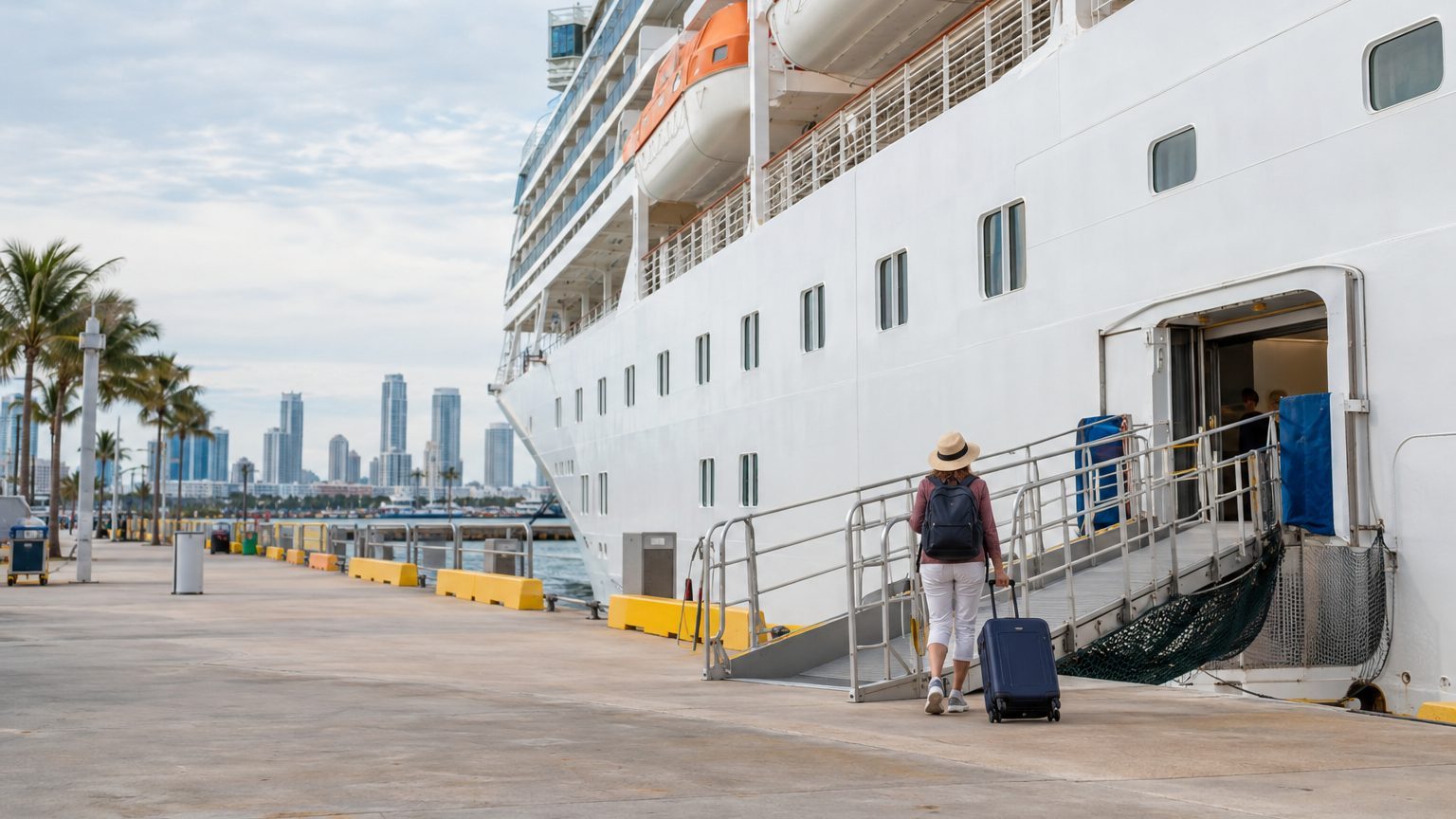
Your passport expired two years ago, the sailing leaves Miami on Friday and returns to Miami on Monday, and the cruise line’s app keeps nagging you to upload a passport. You can board without one. For U.S. citizens, a round trip that starts and ends at the same U.S. port falls under the closed-loop exception to the Western Hemisphere Travel Initiative, the federal rule that normally requires a passport at the border. The exception covers getting on the ship and getting back into the country. It does not cover what happens if something takes you off the ship in the Bahamas.
Where the closed-loop rule stops
“Closed-loop” has a precise meaning: the ship returns to the exact U.S. port where the voyage began. A Fort Lauderdale departure that ends in Miami, or in San Juan, is not closed-loop, and a passport book is needed. Fly-cruise packages fail the test too. If you fly to Nassau to board a ship there, or fly home from a port at the end, the international flight puts you under ordinary air rules.
Those air rules are strict. A U.S. citizen flying to or from the Bahamas needs a passport book, and a passport card, a birth certificate or a REAL ID driver’s license will not get you through airline check-in. The Bahamas is a sovereign country, not a U.S. territory like Puerto Rico or the U.S. Virgin Islands, so the trip is international even on a three-night sailing.
Documents that work at the pier
For adults on a qualifying round trip, the accepted proofs under U.S. Customs and Border Protection (CBP) rules are a passport book, a passport card, or an original or certified birth certificate paired with a current government-issued photo ID, usually a driver’s license. Enhanced driver’s licenses, issued by a handful of states, are also accepted. The passport card is the cheap middle option: it works at seaports but is useless on an international flight.
The birth certificate is where people get turned away. It has to be a state-issued original or certified copy with an official seal, raised or printed. Hospital-issued certificates with footprints do not qualify, and neither do photocopies, even notarized ones. Puerto Rico birth certificates issued before July 1, 2010 are no longer valid, because the island invalidated the older ones.
A REAL ID is a separate trap. The star on a REAL ID license shows that the card meets domestic security standards for flying within the U.S. It does not prove citizenship, so it counts only as the photo ID half of the pair, and you still need the birth certificate. Check that the license has not expired, since the photo ID has to be current.
Children and teenagers
Under the same CBP rule, U.S. citizens under 16 need only proof of citizenship, normally a certified birth certificate, with no photo ID. Teenagers 16 and older follow the adult rule: birth certificate plus photo ID, or a passport. A school ID usually works as the photo ID.
Some cruise lines go further than the federal minimum, and one parent sailing alone with a child is where lines tend to ask the most questions. Carrying a notarized consent letter from the absent parent is standard practice. Infants who might ever need to fly home need their own passport book like everyone else.
Why a passport is still the safer choice
The U.S. State Department’s advice to cruise passengers is to carry a passport book even when the cruise line does not require one. The reason is mechanical. Suppose you miss the ship in Nassau, or a medical problem means flying home while the rest of your party sails on. A birth certificate and a passport card are both useless at the airline counter, and a passport book is the only document that will get you onto the plane.
Without one, you are applying for an emergency passport through the U.S. Embassy in Nassau while the ship moves on. That means proof of citizenship, a photo and a fee, and in the meantime you are paying for a hotel room and rebooking flights. For a four-night cruise, the cost of one missed sailing can exceed the price of getting a passport.
A passport book also covers itinerary changes. Hurricanes and mechanical problems occasionally reroute ships, and a revised itinerary can bring in a foreign port or a different disembarkation city. With a passport you are covered either way.
Cruise line and port rules
Federal law sets the floor, not the ceiling. Cruise lines can require a passport for a particular route or passenger category, so the document policy on your booking confirmation is the one that counts. Read it before you pack, and check the embarkation port, the final port and every country on the itinerary.
The Bahamas has its own rules, too. U.S. tourists do not need a visa for stays of up to 90 days. Bahamas tourism guidance says non-Bahamian visitors need a passport valid for six months, while State Department guidance for U.S. travelers says the passport must remain valid through departure. If your passport has under six months left and you plan to use it, ask the cruise line before sailing, or renew first.
The closed-loop exception is a U.S. re-entry rule, and the Bahamian side can look different in practice. Bahamian officials have discretion to ask for more documentation, and some ports treat the rule differently from CBP. Most passengers on a closed-loop sailing step off in Nassau or Freeport with a ship card and a photo ID and are fine. If you want certainty, the passport book is the document that settles every one of these questions.
One last route to rule out: the Florida-to-Bahamas ferry run by Baleària Caribbean. It is not a cruise, and the operator accepts only a passport book or passport card from U.S. adults and children alike, with no birth-certificate option.