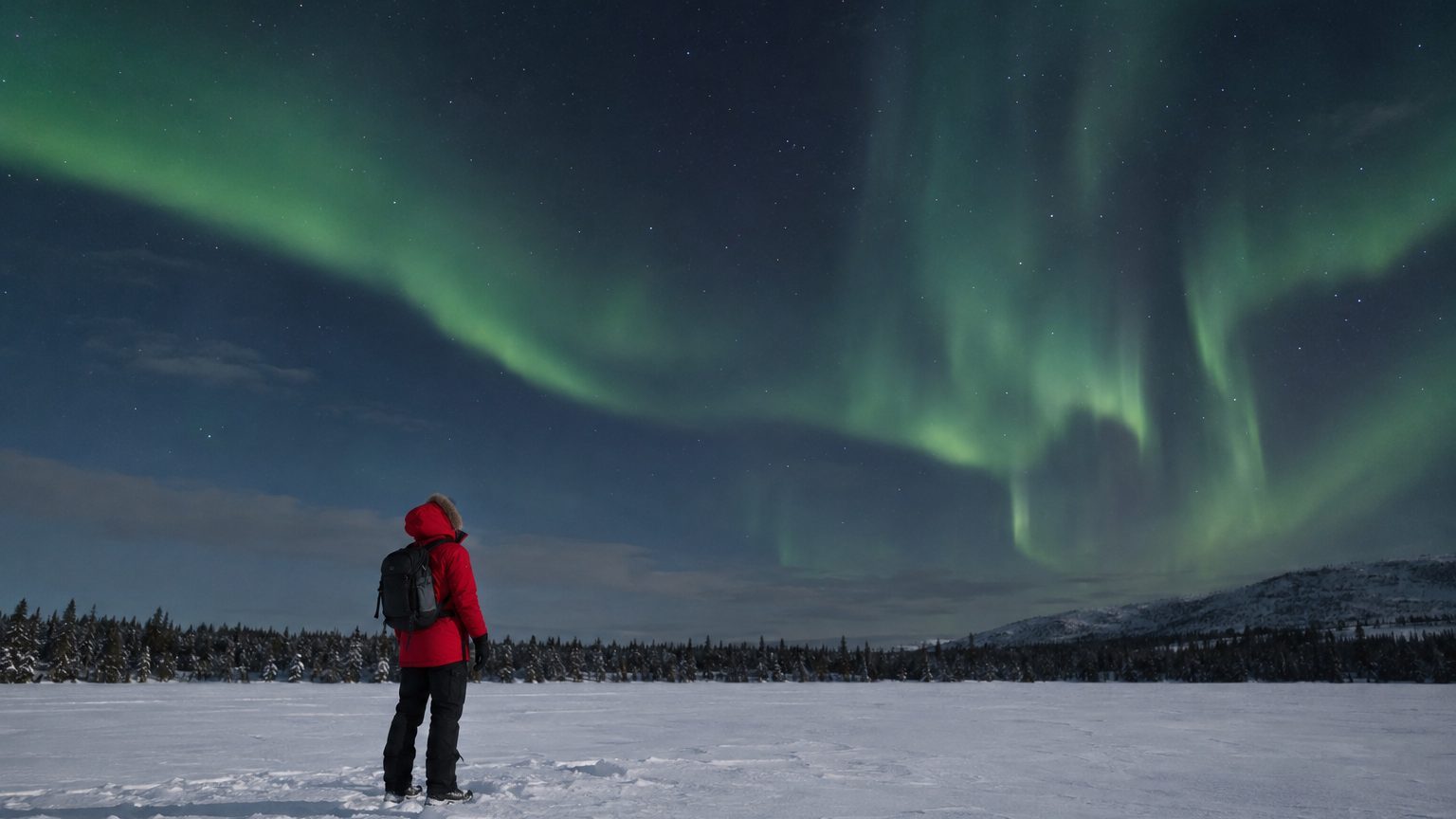
The aurora season in Alaska runs from late August to mid-April, and the sweet spot for most travelers falls between September and March. Within that window, the hours that matter most are roughly 10 p.m. to 3 a.m., with a peak around local midnight. Fairbanks, sitting almost directly beneath the auroral oval, is the base that gives you the best odds of seeing the lights on any given clear night.
Why the calendar matters more than the cold
Auroras happen year-round. You just can’t see them in summer.
From roughly mid-May to late July, interior Alaska never gets properly dark, and the sky stays too bright for even a strong display to register. Darkness returns in August, and by late August the first viewing nights begin. The fall months of September and October bring something winter can’t: milder temperatures, often hovering around freezing at night, and fall colors fading out just as the sky wakes up.
Many aurora guides point to the weeks around the equinoxes, in March and September, as statistically strong periods. Geomagnetic activity tends to run higher then because of how Earth’s magnetic field aligns with the solar wind. It’s a real, documented effect (called the Russell-McPherron effect), though it’s a tilt in the odds, not a guarantee.
Winter, December through February, offers the longest nights and the most viewing hours. It also offers real cold. Fairbanks routinely sees overnight lows well below 0°F in January, and stretches of minus 30°F or colder are not unusual.
March is the compromise many veterans prefer. Nights are still long, daytime temperatures climb, and snow cover remains deep enough for dog sledding, snowmobiling and cross-country skiing during the day.
The hours that count
Forget dusk. The best displays usually arrive late.
Aurora activity tends to peak in the hours surrounding magnetic midnight, which in Fairbanks lands a little before local clock midnight in winter. Most tour operators run their outings from about 9 or 10 p.m. until 1 or 2 a.m., and serious chasers stay out later. Displays can flare briefly at 8 p.m. or glow at 4 a.m., but the 10 p.m. to 3 a.m. stretch is where patience pays off.
Clear skies matter as much as solar activity. A strong storm behind a thick cloud deck is invisible, and a faint glow under crisp, dry air can be spectacular. Check the cloud forecast first, then the aurora forecast.
The University of Alaska Fairbanks Geophysical Institute publishes a free aurora forecast on a 0 to 9 scale, and the NOAA Space Weather Prediction Center posts a three-day outlook and real-time data. In Fairbanks, even a low reading of 1 or 2 can produce a visible display, while farther south, in Anchorage, you typically need a much higher number.
The moon plays a quiet role too. A full moon washes out fainter aurora and cuts contrast, though bright displays still shine through. Scheduling around a new moon gives you the darkest backdrop.
What makes Fairbanks the top base
Geography does the heavy lifting here. Fairbanks sits at about 65° north, under the auroral oval, the ring of peak activity around the magnetic pole. That position, combined with a dry interior climate that produces fewer cloudy nights than the coast, gives the city a strong track record: the Geophysical Institute has long said that if you stay for three nights in the season, your chances of seeing the aurora are very high, often cited above 90 percent.
Three nights. That’s the number to plan around.
Infrastructure seals the deal. Fairbanks has an international-feeling tourist economy built around the lights, with a major airport, rental cars, and lodges that offer wake-up calls when the aurora appears. Heated viewing cabins, yurts and guided outings sit within a short drive of town, and many operators supply insulated parkas and boots, so you don’t need to buy a winter wardrobe for one trip.
Chena Hot Springs Resort, about an hour east of the city, adds a postcard-worthy twist: soaking in a naturally heated outdoor pool while green ribbons ripple overhead. Light pollution near the resort is minimal, and the combination of steam, snow and sky is the image most people carry home.
Anchorage is the common alternative, mostly because flights are cheaper and more frequent. But it’s roughly 360 miles south of Fairbanks, closer to the edge of the oval, with city glow and more coastal cloud. Auroras do appear there, just less often and usually lower on the horizon.
Going farther north, to Coldfoot or Utqiagvik, pushes you toward the top of the oval, where the lights can appear overhead less consistently, and logistics get far harder and pricier. For most visitors, Fairbanks hits the balance of reliability and ease.
Planning the trip so the odds stay in your favor
Book at least three or four nights, and leave your schedule loose. Treat the first clear evening as your best shot instead of waiting for a better one that may not come, since weather can turn quickly.
Dress in layers: a moisture-wicking base, an insulating mid-layer, and a windproof outer shell, plus insulated boots rated for deep cold. Hand and toe warmers are cheap insurance. Camera batteries drain fast in subzero air, so keep spares inside a jacket pocket.
For photos, a tripod and a camera with manual settings go a long way. A wide lens, an exposure of roughly 5 to 15 seconds and a high ISO will capture colors your eyes may see as pale gray-green. Modern phones with night modes can do respectable work too.
Mind the calendar for prices. Late February through March is popular and fills up early, while September is quieter and often cheaper. Winter flights into Fairbanks connect mainly through Anchorage or Seattle, so allow for delays when winter storms roll in.
One last detail worth knowing: the sun runs on an roughly 11-year cycle, and activity has been elevated since the solar maximum period around 2024 and 2025. Strong displays remain more frequent than average through the next couple of seasons, which makes this winter a particularly good time to go.